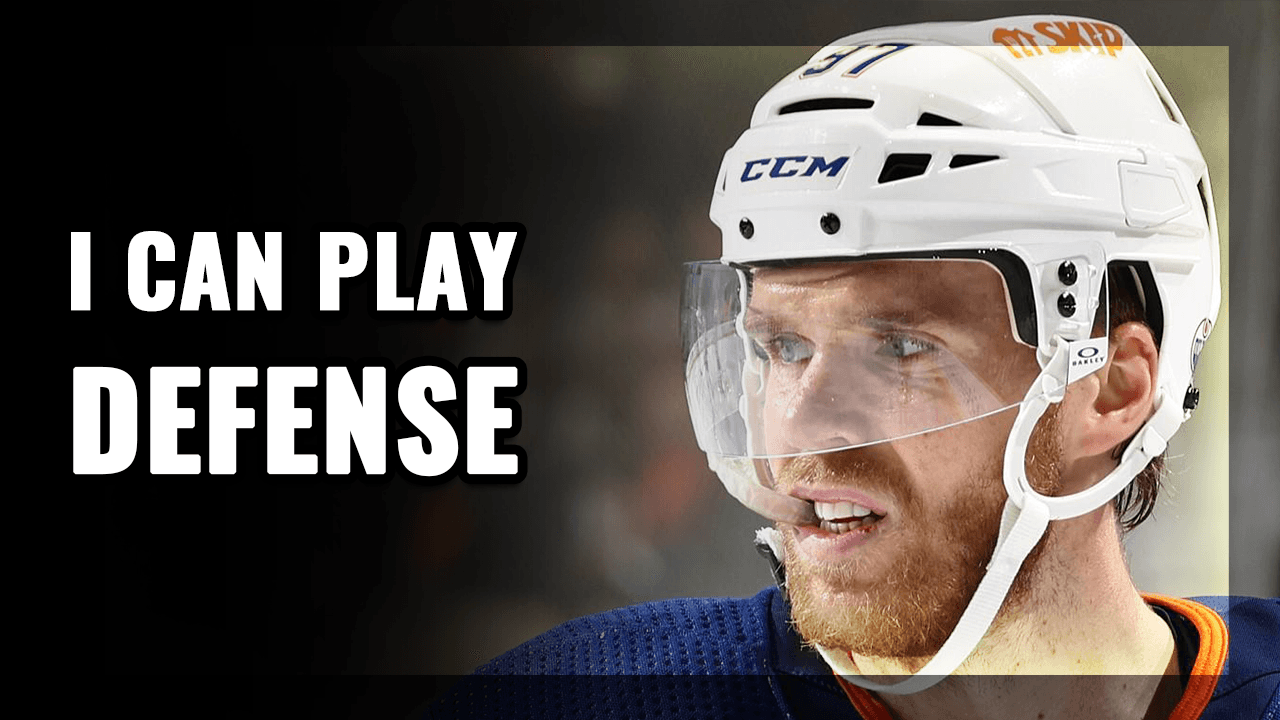
It’s easy to know which hockey players are good at offense. We just look at who has a lot of points. What about defense? This certainly gets more complicated. In the past it was just whoever had that reputation of a ‘good defensive player,’ which is not objective, and it severely underrated players in smaller markets.
This brings us to Connor McDavid. The Oilers last season faced a lot of scrutiny about their defense, but is McDavid one of those great offensive players who can’t actually play D? While he isn’t perfect, he is excellent defensively if we consider the fact that he plays against other #1 lines. Every advanced stat says so, and if you watch his games, he is doing work on the ice, obviously.
However if you are the Oilers head coach, your goal is to win games, not boost up McDavid’s (defensive or offensive) stats. In a close game where the opposing team pulls their goalie or on important PKs in the playoffs, who are you putting out there? Is McDavid better at defense than the defensive forwards on the Oilers? According to Kris Knoublach, yes, but let’s dive deeper.
Do Forwards need to play Defense?
For the top forwards of our generation, it’s easy to point to Crosby, Ovechkin, Mcdavid, MacKinnon, Kucherov, and Draisaitl (and many more), but who could both score and play defense? Does it even matter if they can play defense?

Too long have many defensive geniuses been underrated or ignored until the more popular usages of advanced stats. Recent discussion around Ovechkin and his defense have surfaced with the conclusion that he is not only just ‘bad at defense,’ but downright horrible. Above is a chart showing loose puck recoveries and successful defensive touches per 20 minutes TOI. While it seems like Bergeron is by far the best, Ovechkin is by far the worst for the 2019-20 season. Yes, Ovechkin is older here. He probably played much better defense when he was younger, but it brings questions to many player’s overall hockey ability. We all would love Bergeron on our team, for example, but in the mainstream stat sheet of goals, assists, and points, he would never show up as a top player.
Now for those who are familiar with hockey, we all know that Centers are critical for both offense and defense. Wingers are much more replaceable and are usually the offensive experts. This means that the chart above is heavily biased in favor of centers, as we mainly see centers as the kings of these stats in the top right with wingers like Ovechkin performing worse. This is to be expected. While I’m not defending Ovi’s two-way game, this chart definitely makes him look worse than he is. Essentially, we can’t really judge wingers by their defensive abilities unless they are comically good or bad because out of all the forwards, it’s normally the center’s job to shore up the defense. This means wingers like Kucherov and Ovechkin kind of get a pass for not being the best defenders. For McDavid, he does not get this pass. As a center, he needs to be good at defense.
How important is Defense compared to Offense for Forwards?
Hockey is a two-way game, unlike football, and in hockey, defense is extremely important, unlike baseball. It’s quite rare for NFL players to play on both offense and defense, and in baseball, your offensive stats heavily outweigh your defense both in statistical and fan perception (unless you are a catcher). Defense in hockey is incredibly important.
However, that does not mean defense is more important than offense. As a head coach or a GM, you must manage your roster’s ice time and salary cap. Paying for an abundance of defense is not usually a good idea because hockey is a very top heavy offensive sport, meaning the best offensive players are much better than the average. Defense on the other hand, is not very top heavy. Sure the best defenders are better than average defenders, but they aren’t multiples better. If not, either Bergeron would have 5 cups or be the highest paid player in the league. Meanwhile, having someone like Jaromir Jagr on your team can single-handedly make your entire team’s offense (and overall performance) look good (check the Rangers in 05-06). As a GM, it’s an easier job to balance the salary cap for offense and defense, but what about the head coach?
If we assume that McDavid is fantastic at both offense and defense, would you rather him play in the defensive zone or offensive zone? The obvious answer is the offensive zone because fantastic offense is more impactful than fantastic defense. This means a coach cannot put McDavid in high pressure defensive situations too often because he needs to save his ice time for offense where he would get more value. This is often why many 1st line players do not play on the penalty kill even if they are capable of it. You would much rather save his ice time for after the penalty and try to get that precious offense going. The opposite is also true, where we see Ovechkin take almost all the powerplay time. It’s that important to allocate your ice time for your offensive players to shine.
Overall, defense is still important even if offense is more. From a value perspective, because the highest paid players are mainly offensive players, if you can get a good shutdown player that is cheaper and have them play against and shutdown the opponent’s top offensive players, you are essentially neutralizing the opposing team. This allows your own offensive stars to shine and hopefully win the game from better asset allocation.
How to evaluate a Forward’s Defense
Now that we know defense is important, but not the most important, we must ask: is McDavid good at defense?
As mentioned before, measuring someone’s defensive skills is somewhat difficult in hockey. Hits, Blocked Shots, these stats are nice to look at but don’t really paint the real picture of one’s defensive abilities.
One archaic way to evaluate Defensemen is to see how much ice time they get each game and how often they are utilized in the defensive zone and high danger situations. You see this very often when coaches decide who is playing in the top defensive pair and who gets the defensive zone faceoffs. Despite being so rudimentary, it’s actually a pretty good metric because it’s decided by an NHL coach, aka someone who is paid millions and whose literal job is to evaluate his players and utilize them to their maximum potential. We essentially have a highly qualified expert who has much more information than is publicly available making these decisions (unfortunately NHL coaches are still human and obviously make lots of mistakes, so this metric is not the best, and it can only tell you how good a defenseman is relative to the rest of their team’s D core). The same can sometimes be said for Forwards, but it’s a bit trickier since their offensive talent is taken more into consideration, so we need an alternative way of measuring the coach’s opinion for evaluating forward defensive talent.
Note: For a quick overview of someone’s defensive abilities, check more into their defensive WAR or similar aggregated metrics from any advanced hockey stat site. These quick reference stats often have limitations and biases, so for more in-depth views, look at each individual stat that usually builds those metrics such as Puck Retrievals/Recoveries, Corsi/Fenwick, Defensive Zone Starts (and /60), xGA, Giveaways in Defensive Zone/60, and many more.
For the Winnipeg Jets, we can easily see who is most trusted in the defensive zone in high pressure situations. In the playoffs, pretty much every time the opposing team pulled their goalie, they played the line with Lowry/Appleton. This shows that the coach trusts these two players as their defensive experts. While these two players might not have the best advanced defensive stats, they often take defensive zone draws or start their shift in the defensive zone, which skews their data to appear worse than how they actually perform. Note: there are many different approaches for each coach. Some coaches just put whoever is freshly rested out there, some put their first line out, some put their defensive experts out.

What does the Oilers head coach Kris Knoublach do? In the regular season, McDavid plays in close games and is used to protect leads, but he is also on the ice so much that it’s tough to judge whether he’s used as a defensive player or if he’s just out there because he’s rested and has 1st line minutes. However, he does not play on the penalty kill in the regular season, but did in the 24-25 playoffs. This means he’s the trusted guy. They would also put him in late 3rd period situations in close games, but that’s mainly because he is just an amazing player rather than being a defensive expert.
During the regular season, McDavid was in the top quartile of xGA/60 at 2.31. Meanwhile his xGF/60 is 2nd in the league at 3.56, making is xGF% 5th in the league at 60.67%. Again we have to consider the fact that he faces top lines, and xGF and xGA does not account for how strong your opposition is, which makes it even more impressive that he is at the top offensively, but also in the top quartile defensively. The same can be said for every defensive stat like Corsi-Against, HDCA, etc. TLDR he plays against the likes of Kucherov, but still performs well above average defensively, which means his stats would look much better defensively if he was playing against bottom 6 forwards. We can’t fully trust a stat like xGF and xGA for bottom 9 forwards, but it’s definitely extremely useful for 1st liners.
Lastly, we have to understand that offensive players sometimes ‘cheat’ a bit on defense. At the end of the day, having a good xGA doesn’t mean much if your xGF is low. Cheating a bit on defense to get positive expected value on xG is definitely well worth the risk, and that’s something good players do all the time regardless of their offensive talent. While McDavid’s simple and advanced defensive stats might look a bit human, it’s because he’s not out there with the sole purpose of improving it. He’s out there to play some good hockey which includes both offense and defense.
Connor McDavid could be the best Penalty Killer
I want to have a special section to talk about McDavid’s penalty killing. In 2025 he only killed penalties in the playoffs. This means he only faced good teams and presumably good powerplays. How did he do? He was in the top ~30% in most defensive metrics such as xGA, SCA, CA, etc. However, his partner, Zach Hyman was first in almost every metric. Hyman unfortunately got injured before playing against the Panthers (who had 30% PP vs EDM), and McDavid was right up there as the best penalty killer in the playoffs until after that series. Had the Florida series not happened, or perhaps if Hyman was there, McDavid might have had the best penalty killing stats in the playoffs.
Of course the playoffs are a small sample size, but we have to remember that McDavid did not penalty kill all season. You are good at what you practice, and all the other top PK forwards were PKing all year such as Aho, Jarvis, and Barkov. Had he put in the PK reps during the regular season, he might have looked even better, but then the Oilers have an injury risk or less offensive zone time for the best player in the world.
I think it’s safe to say that we can dispel the myth that the best offensive players are bad at PK. Many, such as McDavid, simply don’t PK because their time is better spent elsewhere. When he does PK, he is above average despite not practicing it all year in real game situations. Perhaps with a whole career playing on the PK, he could have been one of the best at it.